|
|
|
2017. Early Works (Silvius Leopold Weiss)
 "Schon 2006 hatte sich Joachim Held diskografisch mit dem berühmten Lautenisten Silvius Leopold Weiss beschäftigt. Auf den beiden CD-Rezitals „Deutsche Lautenmusik aus dem Barock“ sowie „Barockmusik aus habsburgischen Landen“. Nachdem sich Held in den letzten Jahren der europäischen Lautenmusik von England über Frankreich bis Italien gewidmet hatte, ist er jetzt wieder zu Weiss zurückgekehrt. Und wie schon der Titel „Early Works/Frühe Werke“ andeutet, stehen nun Suiten bzw. Sonaten auf dem Programm, die vor Weiss‘ Anstellung an der Dresdner Hofkapelle im Jahr 1718 entstanden sind. Die ausgewählten Kompositionen stammen aus dem Zeitraum 1706 - 1717 und spiegeln nicht nur die einzelnen Karrierestationen wider, mit denen Weiss schon früh seinen Ruf als einer der bedeutendsten Lautenisten untermauerte. Die traditionell aus Tanzsätzen bestehenden Suiten, aber auch Einzelsätze wie eine Fantasie stehen für Weiss´ Können, den Einfluss der damals führenden Musiknationen Frankreich und Italien von hochvirtuos über galant bis introvertiert in seine Stücke einfließen zu lassen. Allein die Ausdruckspalette der fünfsätzigen c-Moll-Sonate ist derart reich, dass man es kaum glauben möchte, dass Weiss erst 19 Jahre alt gewesen sein soll, als er das Werk 1706 in Düsseldorf schrieb. Die Faszination an dieser „dreidimensionalen“, antivirtuosen Seelenmusik kann sich eben nur einstellen, wenn sie in den Händen eines Könners wie Joachim Held liegt. Der ganze Reichtum dieser Musik vermittelt sich aber nicht nur über Helds auch im Zarten funkensprühendes Spiel. Erheblichen Anteil an diesem 70-minütigen Lautenglücksmoment hatten auch die Tontechniker, da sie die Erlöserkirche in Vahrendorf in einen Aufnahmeort verwandelt haben, in dem die Laute und nicht der Hall der Star war." "Schon 2006 hatte sich Joachim Held diskografisch mit dem berühmten Lautenisten Silvius Leopold Weiss beschäftigt. Auf den beiden CD-Rezitals „Deutsche Lautenmusik aus dem Barock“ sowie „Barockmusik aus habsburgischen Landen“. Nachdem sich Held in den letzten Jahren der europäischen Lautenmusik von England über Frankreich bis Italien gewidmet hatte, ist er jetzt wieder zu Weiss zurückgekehrt. Und wie schon der Titel „Early Works/Frühe Werke“ andeutet, stehen nun Suiten bzw. Sonaten auf dem Programm, die vor Weiss‘ Anstellung an der Dresdner Hofkapelle im Jahr 1718 entstanden sind. Die ausgewählten Kompositionen stammen aus dem Zeitraum 1706 - 1717 und spiegeln nicht nur die einzelnen Karrierestationen wider, mit denen Weiss schon früh seinen Ruf als einer der bedeutendsten Lautenisten untermauerte. Die traditionell aus Tanzsätzen bestehenden Suiten, aber auch Einzelsätze wie eine Fantasie stehen für Weiss´ Können, den Einfluss der damals führenden Musiknationen Frankreich und Italien von hochvirtuos über galant bis introvertiert in seine Stücke einfließen zu lassen. Allein die Ausdruckspalette der fünfsätzigen c-Moll-Sonate ist derart reich, dass man es kaum glauben möchte, dass Weiss erst 19 Jahre alt gewesen sein soll, als er das Werk 1706 in Düsseldorf schrieb. Die Faszination an dieser „dreidimensionalen“, antivirtuosen Seelenmusik kann sich eben nur einstellen, wenn sie in den Händen eines Könners wie Joachim Held liegt. Der ganze Reichtum dieser Musik vermittelt sich aber nicht nur über Helds auch im Zarten funkensprühendes Spiel. Erheblichen Anteil an diesem 70-minütigen Lautenglücksmoment hatten auch die Tontechniker, da sie die Erlöserkirche in Vahrendorf in einen Aufnahmeort verwandelt haben, in dem die Laute und nicht der Hall der Star war."
RONDO, September 2017
"Wieder einmal erstaunt und bezaubert Meister-Lautenist Joachim Held mit Entdeckungen um das Jahr 1712."
Literatur SPIEGEL, August 2017
"...und spielt die frühen Kompositionen des Meisters mit einer faszinierenden farblichen und dynamischen Palette sowie spieltechnischem Raffinement."
Pizzicato, August 2017
"Geiler kann man das nicht spielen. Da stimmt für mich wirklich alles, der Ton, der Groove, die Artikulation, die Stringenz. Jeder Charakter tritt plastisch und beredt hervor und jeder Ausdruck ist tief empfunden und glaubwürdig. Das ist eine Scheibe für die einsame Insel, die ich immer und immer wieder hören will! Danke für diese Offenbarung!"
Frank Bungarten, Juli 2017
|
-
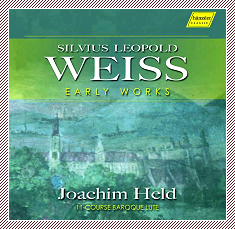
Silvius Leopold Weiss
Early Works
(Release Date: 2017)
|
|
2013. The Original Lute Works (J.S. Bach)
"2012 veranstaltete Joachim Held in seiner Funktion als Lauten-Professor an der Bremer Hochschule für Künste das 1. Lautensymposium. Und in den drei Tagen brütete man über eine Frage, die die Musikwelt zwar nicht in Atem hält, aber dafür die Lautengemeinde schon lange beschäftigt. Wie viele Werke hat denn Johann Sebastian Bach nun explizit für dieses Instrument geschrieben? Offiziell werden sieben Kompositionen Bach zugeschrieben. Und obwohl sie sich auch in Gitarrenfassungen großer Beliebtheit erfreuen, hat man immer noch nicht den Stein des Weisen gefunden. Joachim Held jedenfalls ist nach reiflicher Analyse auch der spieltechnischen Anlage der Werke zur Überzeugung gekommen, dass einzig die Suiten BWV 995 & 1006a sowie Präludium, Fuge und Allegro BWV 998 als Originallautenwerke gelten können. Diese Meinung hat er nun auch in seinem Booklettext zur Einspielung unterstrichen, die kurz nach dem Gedankenaustausch mit seinen Kollegen entstanden ist. So schreibt er in seinem Résumé: „Hinsichtlich dieser drei Werke […] ist die Wahrscheinlichkeit sehr hoch, dass sie tatsächlich für die Laute entstanden.“ Trotz der Gewissheit, die aus dem Album-Titel „Die originalen Lautenwerke von J. S. Bach“ spricht, scheint da dennoch ein Restzweifel zu bestehen, mit dem sich wohl weitere Symposien den Kopf zerbrechen müssen. Unlängst hat Helds Lehrer Hopkinson Smith seine Gesamteinspielung der für Laute bearbeiteten Cello-Suiten von Bach komplettiert. Und hat man noch dessen klangliche Variabilität bei gleichzeitiger Gedankentiefe im Ohr, übertrumpft Held seinen alten Herrn und Meister dann doch noch mal. Die gesamte farbliche und dynamische Palette kommt bei ihm mit einer makellosen Leichtigkeit daher. Sein Instrument kann sich in seinen Händen in einen großen, atmenden Körper verwandeln und
zwischendurch mit Charme und Delikatesse dahin tänzeln. Und auf die einfühlsame Milde lässt Held konturenreiche Taghelligkeit selbst im Kontrapunktischen folgen. Nun könnte man die Aufnahme als stärkstes Argument für Helds Thesen begreifen. Doch deswegen wird er sich (hoffentlich bald) nicht weniger engagiert für die "unechten" Bach-Werke einsetzen."
Rondo, Guido Fischer - August 2013
"Bach schätzte die Laute, auch wenn er sie nicht selber spielte. Das Bachwerk zu diesem Instrument ist übersichtlich, aber hat es in sich.
Sehr wahrscheinlich hat sich Johann Sebastian Bach nicht aktiv als Lautenist betätigt. Zweifellos aber schätzte er dieses Instrument und setzte es in einigen Leipziger Kirchenwerken an exponierter Stelle ein – so z. B. in Arien der Johannes- und der Matthäus-Passion sowie der Trauerode. Die Kompositionen für Laute solo nehmen allerdings im Rahmen von Bachs Gesamtwerk nur einen kleinen Teil ein, wobei allein zwei der erhaltenen Lauten-Suiten Bearbeitungen von zuvor verfassten Werken für Violine bzw. Violoncello solo darstellen. Trotz des kleinen Werkbestandes und der nicht immer problemlosen technischen Umsetzbarkeit auf der Laute handelt sich um herausragende Kompositionen der Barockepoche für dieses Instrument.
Transparent
Der Lautenist Joachim Held hat sich nach jahrelanger Beschäftigung nun den Bachschen Lautenwerken in einer Aufnahme zugewandt. Unter dem Titel „Die originalen Lautenwerke“ vereint er die drei Kompositionen, die seiner Meinung nach sicher von Bach für die Laute vorgesehen waren (und nicht etwa für ein Lautenklavier oder ein anderes Tasteninstrument).
Joachim Held spielt die Kompositionen mit großer Souveränität und feinem künstlerischen Ausdruck. Die gesamte Aufnahme strahlt eine große Ruhe und Abgeklärtheit aus, Held vermeidet grundsätzlich überstürzte Passagen und übertriebene Tempi oder aufgesetzt wirkende Effekte. Sorgfältig gestaltet er in den Fugen die kontrapunktischen Strukturen, wägt Haupt- und Nebenstimmen ab und nimmt eine feinsinnige dynamische Gliederung vor. Die schnellen Tanzsätze der beiden Suiten geraten nie zu einem Wettlauf gegen die Uhr, hier steht für Joachim Held an erster Stelle die transparente Klanglichkeit.
Zugute kommt ihm sein überaus klangschönes Instrument und die hervorragende technische Qualität der Aufnahme. Die Laute – wahrlich kein einfach aufzunehmendes Instrument – klingt voll, obertonreich und rund sowie in allen Bereichen ausgewogen, während etwaige Spielgeräusche auf ein Minimum reduziert sind."
Kulturradio, Bernhard Schrammek - August 2013
"Joachim Held hat seine musikalische Exzellenz schon vielfach in Aufnahmen mit Werken aus Renaissance und Barock unter Beweis gestellt. Lange hat man auf seine Einspielung Bachíscher Lautenmusik gewartet – und das Warten hat sich gelohnt! Unter dem etwas provozierenden Titel Die originalen Lautenwerke stellt Held lediglich drei der sieben von der Musikwissenschaft als von Bach für die Laute vorgesehenen Stücke vor. Mit gutem Grund: Schon im 19. Jahrhundert hegte man Zweifel an der Zuweisung einzelner Werke, und Held begründet in seinem ausgesprochen lesenswerten Booklet-Text die Auswahl überzeugend. Seine Bach-Aufnahme nimmt unmittelbar durch Klangschönheit und musikalische Intelligenz für sich ein: Selbst in komplexeren, polyphon durchwirkten Abschnitten wie etwa dem fugierten Mittelteil des Ouvertürensatzes der g-Moll-Suite BWV 995 bewahrt Held stets Klarheit und schlüssige Phrasierung, in den Tanzsätzen den essentiellen Puls. Nachhaltig beeindruckt hat mich die E-Dur-Suite BWV 1006a, die als dritte der Violinsolo-Partiten Bachs weithin bekannt ist. Zwar scheint die Tonart zunächst eher untypisch und unbequem für die Barocklaute zu sein, Held bezieht sich jedoch auf einige erhaltene Originalwerke aus der gleichen Zeit von Falckenhagen und Kohaut, und durch eine ebenso zeitgenössisch belegte Skordatur (Umstimmung der Saiten) wird das Werk bestens spielbar und klingt völlig lautenidiomatisch. Helds kluge dynamische Entwicklung, die breite Palette von Klangschattierungen, sorgfältige Artikulation und das „rhetorisch sprechende" Gestaltungskonzept bestätigen Joachim Helds Rang als einer der führenden Lautenisten unserer Zeit."
Klassik Heute, Heinz Braun - September 2013
"Joachim Held hat sich jenen Werken zugewandt, die nach seiner Auffassung und Argumentation die originalen Kompositionen Johann Sebastian Bachs für die Laute sind, mit sehr ansprechendem Ertrag dank feinen Spiels.
Die heute als Lautenwerke Johann Sebastian Bachs angesprochenen Kompositionen sind hinsichtlich der Frage, für welches Instrument sie original entstanden sind, nicht unumstritten. Oft führen die als Lautenwerk apostrophierten Arbeiten zu erheblichen spieltechnischen Schwierigkeiten, gelten Bachs Kompositionen für dieses Instrument als nicht perfekt idiomatisch. Joachim Held stellt auf seiner aktuellen Platte mit dem Titel ‚Die originalen Lautenwerke‘ den Versuch an, die wirklich für die Laute konzipierten Kompositionen aus der Siebenzahl herauszufiltern, mit klugen, überzeugenden Argumenten und sehr gutem Ertrag.
Bach auf der Laute ist hochkonzentriert, vielschichtig, besonders das strukturelle Moment betonend – Linearität ist auf einem Zupfinstrument eben ein wesentlich schwieriger herauszuarbeitendes Element. Die von Held als Originale angesprochenen Werke – die Suite g-Moll BWV 995, Präludium, Fuge und Allegro BWV 998 und die E-Dur-Suite BWV 1006a – wirken vollkommen auf der Laute darstellbar und sind wunderbare Beispiele dafür, dass Bach ohne erkennbare Mühen dazu in der Lage war, für sehr verschiedene solistische Instrumente zu komponieren, ohne je in Gefahr zu geraten, seinen Personalstil anpassen oder verändern zu müssen. Unabhängig von der Frage, ob Joachim Held mit seinen Argumenten recht hat: Auch die üblicherweise über diese drei zum Lautenwerk gezählten Kompositionen können natürlich überzeugend auf der Laute gespielt werden, wie von etlichen Größen des Fachs gezeigt wurde.
Introspektive Souveränität
Joachim Held ist stilistisch außerordentlich vielseitig und agiert auch in diesem Programm behände und agil, spielt technisch makellos. Sein Sinn für Bachs Komponieren ist deutlich ausgeprägt – Held deutet das Komplexe verständlich, ohne das strukturelle Moment zu nivellieren. Dabei gehört er gewiss nicht zu denen – egal ob unter Lautenisten, Cellisten oder Geigern – die Bachs Solosuiten auf Biegen und Brechen zu tanzen geneigt sind. Eher folgt Held einem introspektiven, jedenfalls konzentrieren Zugang, gerade die überaus gelungene g-Moll-Suite BWV 995 zeigt das sehr deutlich. Immer wieder, gerade in den langsamen Sätzen, beweist er sein feines Gespür für jene Elemente, die über das Motorisch-Perkussive hinausweisen, entfaltet er eine feine Linearität. Natürlich dominiert spieltechnisch und artikulatorisch das kleinteilige Moment, aber nie wirkt das Geschehen in dieser Hinsicht destruktiv oder ohne Blick für Kontexte, für musikalische Gesamtcharakteristika.
Bei der Wahl der Tempi entscheidet sich der versierte Stilist eher für verhaltene Lösungen, womit er sich konsequent zeigt und seinen interpretatorischen Zugang insgesamt unterstreicht. Der Klang seines leider im Booklet nicht vorgestellten Instruments ist ausgewogen, mit eher gedeckten denn brillanten Registern, die aber sämtlich harmonisch verbunden und gleichermaßen präsent sind. Im Klangbild fallen Klarheit, Plastizität und höchste Konzentration ins Gewicht, bei maßvoller Räumlichkeit. Das Booklet ist zwiespältig: Einerseits überzeugt ein außerordentlich instruktiver, schlüssig argumentierender Text von Joachim Held in deutscher und englischer Sprache sehr, andererseits fehlt jegliche Information zum erklingenden Instrument – bei einer Platte mit solistischer Instrumentalmusik nicht verständlich. Und insgesamt hat die Beigabe eine eher karge Faltblattanmutung.
Joachim Held bildet seine Diskografie mit klug gewählten Schritten weiter: Nach Musik aus England, Italien, Frankreich, den habsburgischen Landen und wenigen weiteren Platten nun also Bach. Held ist auf dem Markt nicht inflationär präsent, besetzt aber die wichtigen Felder sukzessive mit relevanten Beiträgen. Bach war also nur eine Frage der Zeit. Und der programmatisch originelle Beitrag bestätigt Helds Rang unter den interessanten Lautenisten der Gegenwart."
Klassic.com - September 2013
|
-
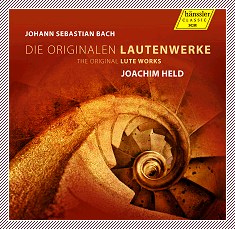
Johann Sebastian Bach
The Original Lute Works
(Release Date: 2013)
|
|
2010. Merry Melancholy
 "With a CD of English lute music of the Golden Age we are very much back on the beaten track. Joachim Held's Merry melancholy, English lute music of the 16th century (Hanssler CD 98.600, rec 2010, 65?) is the latest release from an accomplished performer and experienced recording artist, and the playing is as technically assured and fluent as one would expect from him. There is such an embarrassment of riches in this repertory of well over 2,000 pieces, including the music of Dowland, that choosing material and programming it are principal issues for an artist embarking on such a project. Here, Held plays 25 pieces, grouped in sets by composer: Lusher (an unusual choice to open with), Robinson, Allison, Dowland, Cutting, John Johnson and finally Rosseter; this achieves a balanced and representative selection of the pre-Baroque phase of English lute music. Inevitably the light, charming, lyrical, music of Robinson and Allison's stylistically conservative passymeasures feel like a curtain-raiser to the six Dowland pieces at the heart of the recording, which include Lachrymae (the longest track, at the midpoint of the disc) and the Frog galliard. Held plays Dowland beautifully, and one might have asked for more, but the following sets remind one that Cutting, Johnson and Rosseter too are substantial and imaginative composers. The disc ends with Rosseter's magnificent chromatic fantasia, once attributed to Dowland. My only slight cavil is that, for my taste, the microphones might have been placed a little closer to the lute and in a slightly less resonant acoustic. Nevertheless a fine recording and a valuable survey of an important repertory." "With a CD of English lute music of the Golden Age we are very much back on the beaten track. Joachim Held's Merry melancholy, English lute music of the 16th century (Hanssler CD 98.600, rec 2010, 65?) is the latest release from an accomplished performer and experienced recording artist, and the playing is as technically assured and fluent as one would expect from him. There is such an embarrassment of riches in this repertory of well over 2,000 pieces, including the music of Dowland, that choosing material and programming it are principal issues for an artist embarking on such a project. Here, Held plays 25 pieces, grouped in sets by composer: Lusher (an unusual choice to open with), Robinson, Allison, Dowland, Cutting, John Johnson and finally Rosseter; this achieves a balanced and representative selection of the pre-Baroque phase of English lute music. Inevitably the light, charming, lyrical, music of Robinson and Allison's stylistically conservative passymeasures feel like a curtain-raiser to the six Dowland pieces at the heart of the recording, which include Lachrymae (the longest track, at the midpoint of the disc) and the Frog galliard. Held plays Dowland beautifully, and one might have asked for more, but the following sets remind one that Cutting, Johnson and Rosseter too are substantial and imaginative composers. The disc ends with Rosseter's magnificent chromatic fantasia, once attributed to Dowland. My only slight cavil is that, for my taste, the microphones might have been placed a little closer to the lute and in a slightly less resonant acoustic. Nevertheless a fine recording and a valuable survey of an important repertory."
Oxford Journals, Chris Goodwin - 2011
"Whether or not it's because paying a single lutenist is cheaper than paying a chamber ensemble, to say nothing of a full orchestra, the last few decades have seen the release of a profusion of lute recordings. Those by German lutenist Joachim Held, however, stand out from the crowd. Held is technically superb, capable of producing that effortless quality in which the player's fingers seem almost incidentally to graze the strings. He is backed by fine sound from the reliable Hänssler Classic label, capturing the full range of Held's modern eight-course Renaissance-style lute with a minimum of fuss and extraneous noise. The best feature, however, as with Held's other recordings, is his programming sense. His recordings have explored national styles, in this case the English style. In this he is not alone, but the depth of his exploration is unique. Several of John Dowland's famous works are included, but most of the album is devoted to little-known composers, including Lushier, composer of the lovely opening Almain, who is known only by his surname. The lute pieces by Thomas Robinson, Richard Allison, Francis Cutting, John Johnson, and Philip Rosseter span nearly a century and are not grouped chronologically. Instead, as a lutenist of the age would have done, Held puts them together into sequences that make musical sense and affect the soul. The music seems to pulse with lively detail and then recede into minimalist lassitude, indeed embodying the "merry melancholy" of the album's title. The booklet notes, in German and English, offer biographical detail on the composers for those interested, but even the casual lute lover will find this a compelling recital."
Allmusic.com, James Manheim - 2010
"The concept of "melancholy" held a special place in English art of the 16th and 17th Centuries. Rather than being considered depressive mental condition, it was seen as a deeply poetic element of soaring ecstasy with the power to inspire even bigger, even better deeds. It is no surprise that the subject of "melancholy" came to characterize much of the English music for lute, and the inspiration for much complex and colorful music. Joyful dances, contrapuntal fantasies, and pavanes which luxuriate in chromaticism are all to be found here. Only the most beautiful, haunting works were chosen for this recording. Naturally, John Dowland is represented! His "Lachrimae" was a true international HIT in it's day, and Dowland capitalized on its success by providing numerous editions and arrangements. The program also features the work of other, lesser-known masters such as Francis Cutting, John Johnson and many others who brought the English Lute School to its highest development around 1600. Oh, Merry Melancholy! After having explored the repertoire of France, Italy, Germany and Austria, Joachim Held now presents this CD of English lute music. Throughout these recordings, he has shown not only the diversity which then prevailed in Europe, he also presented his own amazing abilities and stylistic flexibility and mastery of different musical idioms. It shows once again that Joachim Held is one of the best lute players in the world."
5 Av 6 Möjliga I Betyg I Svenska Dagbladet
|
-
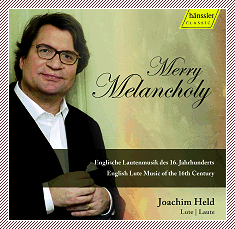
English Lute Music of the 16th Century
(Release Date: 2010)
|
|
2008. Musique pour le Roi
"After his jouney to Italy „Che Soávita“ Joachim Held now stops with his Solo Recital „Musique pour le Roi“ at the Houses of Nobility in France of the Baroque. For this he chose Suites of composers like Jacques Gallot, Charles Mouton and Robert de Visée, who were high esteemed Lutenists who worked near to the highest Nobility like Louis XIV. Since the recordings of Helds teacher, at the latest, Hopkinson Smith these names are known not only to Early Music Enthusiasts. Thank to Joachim Held, who made the lute more popular in the last years, the worth of this precious music will be increased many times.
Superficially the dances follow the normal Suite. Even in the old recordings of Konrad Ragossnig and Anthony Bailes, one could could imagine the internal gestures of this „sound microcosm“, but Held fulfills the concentrated Rhethoric with a variety of Colours and Variability which is only rarely heard. With the Theorbo and 11 - course Baroque lute, which both are from the workshop of Klaus Jacobsen in London, he plays with a admiringly clearness for the contrasts of tension and intensity, which point out the strictness and dignity, Contemplation and Calmness in perfection."
Rondo Magazin, Guido Fischer - October 2008
"In his series of publications the award winning Joachim Held devoted himself to the different traditions of compositions for the family of the luteinstruments: Works from Germany and Habsburg play an eminent role, lately Held worked on the italian repertoire. Now he devotes himself to a very special repertoire – the compositions in the area of the french King Louis XIV. for the Lute. The rich tradition is based on experiments with the tuning of the lute and a creative stylistic treatment of the possibilities of the instrument.
Ennemond Gaultier (1575 – 1651) was one of the moulding personalties, followed by a.o. Charles Mouton (1617 – before 1699) or Jacques Gallot (? – 1690). These Masters brought out the „stile brisé“: finely woven compositions combined with a complex technique of composition, the melodic lines are interrupted. An artificial Mixing of the voices increase the impression of complexity and gives the dance movements an artificial character.
Very successful
Also in this repertoire Joachim Held moves very secure and prudently: He presents himself technically strong, precise and with equally beautiful and reserved. The single movements are not shaped to strong characters but embedded in the whole texture. His fine sound - production shapes the works with not too much energy – which seems to be the perfectly right way. Because the rewarding pieces, which are more reflective then full of temperament need a fine treatment, which Held – never an interpret with too strong pressure – follows all the way through this recording. I addition to that the production was recorded with a very clear sound, which reflects perfectly the structure of the music and every register of the used instruments.
All in all this is a very fine interpretation of this special repertoire, which probably will take an important part in the Discographie of Joachim Held who follows pass as interpret in a convincing manner."
Klassik.com, Dr. Matthias Lange - August 2008
|
-
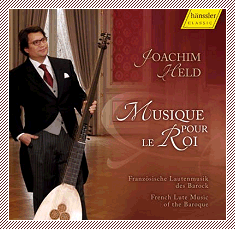
French Lute Music of the Baroque
(Release Date: 2008)
|
|
2007. Che Soavità
"Held's expressive playing is well suited to this repertoire: a combination of opposites, of strength and delicacy, simplicity and sublety. Particular noteworthy is his interpretation of Castaldi's Tasteggio soave, which is hyperbolically described in the sleeve notes as perhaps one of the most exciting chitarrone compositions."
Early Music Review, August 2007
"Again Joachim Held proves, what was already shown in his previous recordings: His technical basis is superior. Convincing fluency, perfect sound fulfill all wishes. Strong dynamic contrasts of the right hand allow a lot of variation. He takes care of the freedom in the Toccatas and by these elements creates an intensive interpretatoric tension."
Klassik.com, July 2007 / Dr. Matthias Lange
|
-
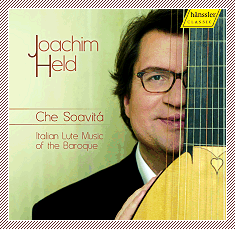
Italian Lute Music of the Baroque
(Release Date: 2007)
|
|
2006. German Lute Music
"Joachim Held is currently considered a star in the world of Early Music… No Festival can be without him and thanks to him the awareness of the lute has considerably grown. What he gets from the instrument is truly astonishing and sounds everything but pedantically old-fashioned."
Böblinger Kreizeitung, June 2006
"With the present programme Joachim Held, however, proves convincingly that next to Bach and his well-known colleague Sylvius Leopold Weiss there were other masters of the lute who reward the interest for them with glorious music."
Klassik-heute.com, June 2006
|
-
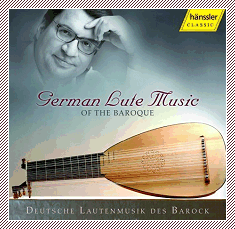
German Lute Music of the Baroque
(Release Date: 2006)
|
|
2006. Delightful Lute-Pleasure
"A busy continuo player. Held is therefore an expansive musical imagination: he deploys those distinctive stylistic traits that are the lifeblood of this music with the utmost taste (especially the stile brisée treatment of not only chords but intervals and the subtle inégales) and suggests orchestral colours with ease."
International Record review, April 2006
"The recordings prove the incredible richness and stylistic range of this intimate music. True, one needs to give on to "music coming from silence". The span of expression inside, the corresponding parts, the humour and the melancholy are so close next to each other. To make them visible, without falling into the trap of wrong dramatising, is the all-decisive art of the player. Held manages this with mastery; his dreamlike secureness of playing with the musical time is without comparison. The calm of the beat guaranties the inner dramatisation in its most beautiful way."
Musikforum, March 2006
"Courageous music making, cheerfully interpreted, it is literally a delight to listen to these recordings."
Lauten, February 2006 (Deutsche Lautengesellschaft)
|
-
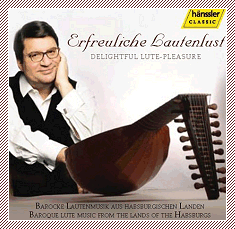
Baroque Lute music from
the lands of the Habsburgs
(Release Date: 2006)
|
|
2005. Lute Music of the Renaissance
"The playing of Joachim Held is characterised by a lucid and pronounced shaping of sound. To give transparency to the polyphonic development and the desire to shape the melodies intensively can be felt as the aim of the interpreter. His artistic expression aims more at making the structures of the music audible than a mere virtuosic playing…. The listener is taken along into a period, which is particularly worth being visited from the perspective of plucking instrumental music. The quality of sound positively completes this successful portrait of this part of lute music."
Concertino, February 2006
|
-
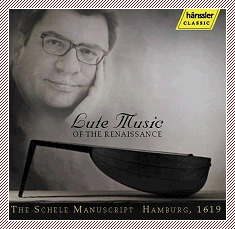
The Schele Manuscript Hamburg, 1619
(Release Date: 2005)
|
|
2004. Nach willen dein
"With the German lute player Joachim held there seems to build up a successor of Hopkinson Smith. With outstanding technical abilities, lucid clarity of playing and an extraordinary imaginary power of interpretation in his recording of German Renaissance lute music a three stared constellation of lute virtues is shining."
Franz Szabo, May 2004
|
-
Deutsche Lautenmusik der Renaissance
(Release Date: 2004)
|
|
1996. I grandi liutisti Milanesi del Cinquecento
"Joachim Held's playing is a real pleasure to listen to. He brings out the character of each piece, from the fluid improvisatory virtuosy of Francesco's Fantasiasand ricer-cars, to the more formally structured fantasias of Paladino, and the rhythmic vitality and energy of Borrono's dance forms. Throughout this recording Joachim Held makes effective use of tonal and dynamic contrast and shows excellent control of tempo and rubato without ever sounding self - indulgent. In the contrapunctual works he shows an impressive control of the different voices of a composition - demonstrated to particular good effect in Paladino's intabulation of "Anchor che col partire" in which the part writing of the underlying madrigal is never less than crystal clear ..."
Lute Society (of England), March 1998
"Joachim Held has a refreshing and virtuosic manner to approach this music, probably comparable to Paul O' Dette's playing. He doesn't indulge in the lute players' caprice to play every harmony with an arpeggio slowing down and putting a veil on the flow of the music. Instead he chooses lively tempi, doesn't consider the word virtuoso as a devil's creation from the 19th century and shapes these master works he is dealing with, consistently and in a transparent way. Being played legato, not staccato, the melodies sound and thereby can be followed through the plait of voices and accompanied on their way by the listener."
Gitarre und Laute, February 1997
|
-
Great Milanese Lutenists of
the Sixteenth Century
(Release Date: 1996)
|
|
Miscellaneous
"With the partly dissonant 'Toccata cromatica" or the rhythmically varying "Partite sopra la Follia" by Allessandro Piccini, Held shows then how differentiated also the darker and louder sounding theorbo can sound - if the player masters, as he does here, to emotionally shape the work with small retardations and frequent change of colours."
Frankfurter Allgemeine Zeitung
"The stylised dance suites and partitas of the late Baroque period also sparkle with enjoyment of masterful virtuosic playing and in the slow parts, the sarabandes, Joachim Held impresses with his concentrated composure with which he allows the harmonies to fade out linking them in delicately woven transitions and decorations."
Lindauer Zeitung
"The word virtuoso fully expresses what Joachim Held is: he is a master of his art..."
Mitteldeutsche Zeitung
|
|
|
|